On Mondays and Thursdays, I go into the office.
Not because my team expects me to. But because I generally find it’s good for my mental health to get out of the house two days a week and work from a new location. (You know — that ancient phenomena of in-person interaction, and all that.)
I have colleagues who are in-office Monday through Friday religiously.
And then I have other coworkers — some who live a mere 20-minutes from the office — who haven’t stepped foot in the office in years.
That, my friends, is the beauty of hybrid work.
What is hybrid work?
Let’s start with a definition of hybrid work.
Hybrid work is the flexibility a company gives its employees to choose whether they’d like to be in-office, remote, or a mix of both.
At Owl Labs, we’re so passionate about hybrid work that we created an annual report about it.
A few quick facts: Since 2020, hybrid work has steadily become the new norm. In fact, while in-office workers still make up the majority of the workforce (63%) as of 2025, our research shows 28% of workers are now hybrid — compared to just 9% of workers who are fully remote.
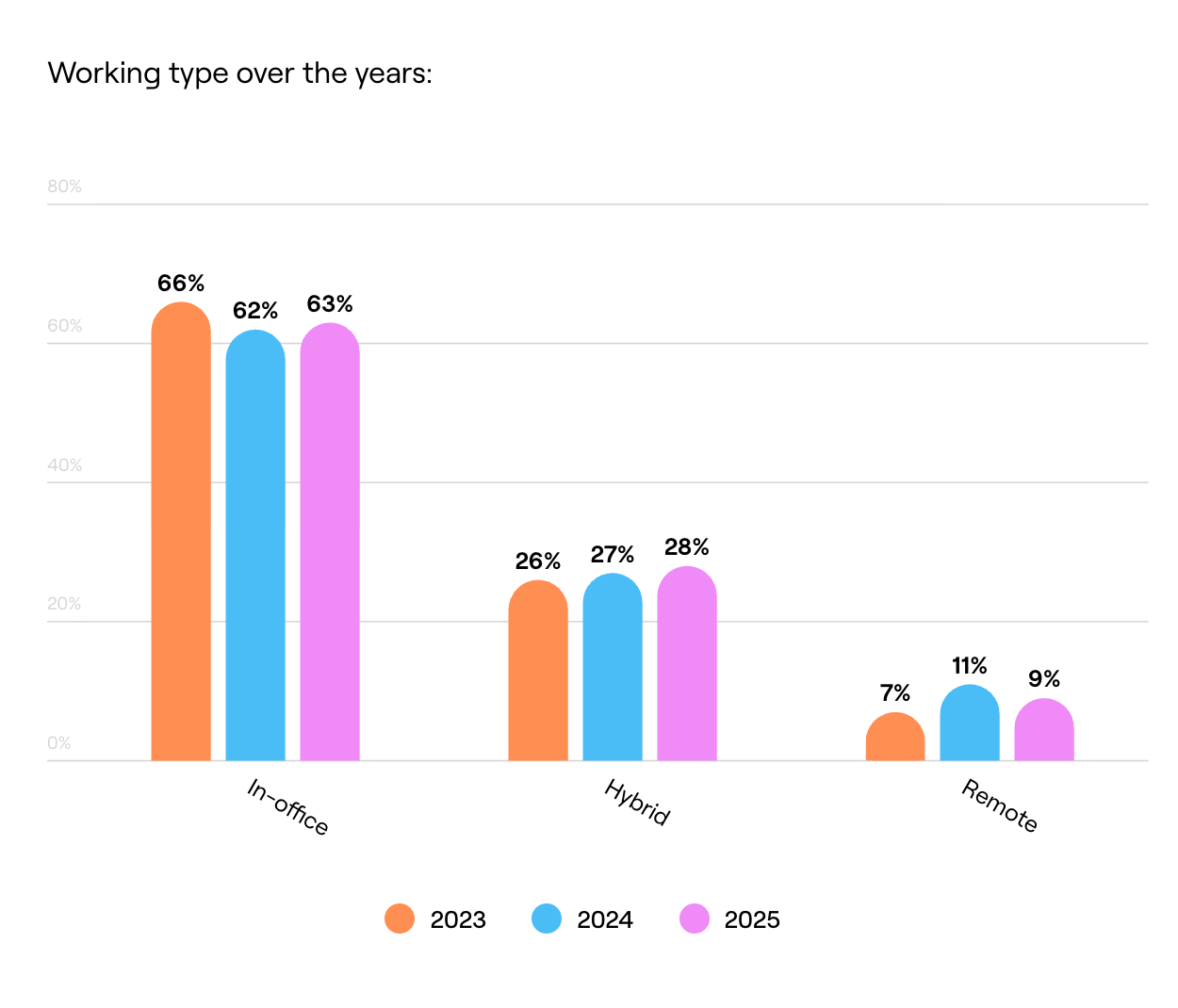
Plus, 73% of workers reported their companies haven’t changed their remote or hybrid policies since 2024.
In other words: Hybrid isn’t going anywhere.
Interestingly, the majority of hybrid employees go into the office 3 days (39%) or 4 days (34%) each week, up from 2024 — suggesting that some employees now show a preference to in-person experiences over fully remote.
Hybrid employees are largely eager to keep their flexible set-ups, though. If flexible work were taken away from them, roughly half (40%) of workers would start job hunting, 22% would expect a raise, and 5% would simply quit.
Is hybrid work just an excuse to work less?
As a hybrid worker myself, let me anecdotally explain a few benefits. On Tuesday nights, I do trivia with friends, which means I won’t have time for an after-work workout. So I stay home on Tuesdays so I can head to the gym on my lunch break.
(Yes, I’m aware I could work out before 9 a.m., but… no.)
On Fridays, I stay home to catch up on some errands in between work responsibilities. I do my laundry, meal prep, and finish up work tasks for the week.
If managers are concerned that this suggests their hybrid workers are slacking off during work hours, they can rest easy. Shockingly, in-office workers are actually far more likely to engage in quiet quitting (67%), compared to hybrid workers (28%).
Hybrid workers are still expected to meet job expectations and are held to the same standards as in-office employees. Most of us wouldn’t head to Trader Joe’s if we had a time-sensitive project that needed finishing, or if a meeting was scheduled during that time.
At its core, hybrid work is about trusting your employees to behave like responsible adults who get to decide for themselves where and how they work best. Sometimes that might mean visiting the office, and other times, they’d prefer to hunker down at their desks at home.
How does a hybrid setup work?
There’s no single “right” way to do hybrid work. Companies implement hybrid work in different ways depending on their culture, goals, and team needs.
Let’s break down a few common hybrid work models.
1. Fixed Hybrid (Company-Set Schedule)
This is where employees are required to be in-office on specific days. For instance, maybe you require employees to be in-office every Tuesday. Alternatively, this model might look like a company that demands a certain number of days (i.e. three days per week), but there’s flexibility on which days an employee chooses.
There are some major collaboration benefits to this. For instance, if a team is looking for a time to meet about an important project, they might schedule that meeting for Tuesday so everyone is in-person.
It fosters more casual collaboration, too. If your entire marketing team is in-office at the same time, it promotes more spontaneous cross-functional work as people catch up and hear about various work initiatives.
This is also the easiest model to keep an office culture alive and well. Otherwise, you risk people coming into the office randomly and sometimes finding the office, well… empty.
But there’s a big trade-off with this approach. This model is far less flexible for employees who want to choose if they visit the office at all, and it also could limit your hiring scope to a specific geographic region. “Forced togetherness” might also create resentment with employees who feel they should get to choose when they visit the office.
2. Flexible Hybrid (Employee-Choice)
This is where employees choose when they come in — or if they come in at all. Essentially, the motto for this approach is “work wherever you work best”.
With this method, team managers might also decide their own norms. Your sales director might request that her team be in the office every Monday through Wednesday for in-person collaboration, whereas the finance team might generally prefer remote work entirely.
Typically, this model results in higher employee satisfaction, and it suggests a culture based on trust. Plus, it’s one of the best models for employees’ work-life balance. If an employee lives an hour from the office, they might not want to spend 2+ hours each week commuting.
The trade-off here is simple. If employees are never required to be in-office at the same time, a lot of implicit signals need to become explicit. In other words: Flexible-hybrid employees might be unsure about when they need to be online, whether a topic is better-discussed async or in a meeting, and if in-person employees are making decisions without them present.
To manage this, all expectations need to be clearly communicated and documented.
3. Remote-First Hybrid
This one is less common, mostly because it’s generally expensive to operate an office you rarely use.
This model means that most of your employees work entirely remote. The office is optional, and is largely used for team offsites, leadership meetings, or collaboration days.
So why would you choose this option? It might mean you can invest in a smaller office space (cough, cough, cheaper real estate). It also gives you access to global talent — if most people are remote you can hire wherever you want.
While the trade-off could be your company culture, it doesn’t have to be. This model just requires a bit more intentional culture-building, such as quarterly or annual offsites, or more virtual professional development opportunities.
4. Role-Based Hybrid
This model means in-office expectations vary by role.
Maybe you decide your sales team needs to be largely in-person. Your marketing org? They can work from home.
This model makes sense in theory because it matches the working style to the job needs. A customer-facing role probably should be in-person, especially if customers visit your workspace. Similarly, some sales leaders will say learning on the sales floor by hearing other sales calls is critical, especially for newer sales reps.
But the trade-off is that some employees might feel this is unfair, particularly if they prefer to work remotely and are required to be in-office almost daily. It also limits your hiring scope for those particular roles — like sales-based roles — to a specific geographic region.
Dos and don’ts when creating a hybrid culture
Once you pick the model that best suits your company's needs, there are still some general dos and don’ts you’ll want to abide by.
Dos:
- Set clear guardrails, such as in-office expectations, availability norms, core collaboration hours, etc. But don’t start micro-managing hours worked. Clarity is always better than control.
- Redesign your meetings to be hybrid-appropriate.
- Train managers differently. Teach them to measure outcomes, not presence; how to spot burnout without physical cues; and how to build trust across locations.
- Document everything. Hybrid companies need to maintain internal wikis and default to transparency so your remote and in-office employees have access to the same information.
Don’ts:
- Promote or give special treatment to in-office folks compared to remote. If you’re going to lean into a hybrid culture, you can’t secretly show preference to in-office employees.
- Create office-first meetings with remote people feeling like second-class citizens. You’ll want to create the right meeting culture so remote people feel just as involved.
Examples of successful companies that implement hybrid work
1. Microsoft
Microsoft uses a fixed hybrid model in which they expect employees to be in-office three days each week.
As Microsoft’s Executive Vice President, Chief People Officer Amy Coleman, puts it, “Our goal… is to provide more clarity and consistency in how we come together, while maintaining the flexibility we know you value. We want you to continue to shape your schedule in ways that work best for you, making in-person time intentional and impactful.”
Depending on your office culture and needs, this could be a strong approach—particularly if those in-office days are designed around collaboration, connection, and decision-making that benefit from being face-to-face.
This model encourages in-person discussion three days a week, while still allowing employees to choose which days work best for them, reinforcing autonomy alongside structure.
2. Spotify
Spotify takes a broader “Work From Anywhere” philosophy within its flexible hybrid structure, encouraging employees to choose the environment where they work best — whether that’s at home, a Spotify office, or another location.
As they put it, “We still strongly believe that work is not a place you go; it’s something you do. We trust that when presented with a choice of where to work, Spotifiers understand that there is a responsibility to actively engage in being impactful… Therefore, we do not believe in mandating everyone back to an office. Instead, we continue to embrace flexibility.”
Spotify has made it clear that hybrid work doesn’t mean every experience is identical. The company emphasizes a “different but okay” approach, acknowledging that working from home and working from the office naturally lead to different experiences. Some moments (like in-office listening lounges) are intentionally designed for onsite collaboration and culture-building, while others translate better to virtual formats.
Rather than forcing parity, Spotify focuses on being transparent about what employees can expect in each setting and designs experiences accordingly.
3. Airbnb
Airbnb operates with a remote-first hybrid model through its “Live and Work Anywhere” policy, which allows employees to live and work from nearly anywhere in the world for up to 90 days per year, with no location-based salary adjustments.
As Airbnb’s “Live and Work Anywhere” page explains, “Our benefits… [prioritize] flexibility to meet individual needs.”
Employees receive quarterly travel credits, an annual education stipend, and a quarterly Live and Work Anywhere allowance. Benefits are designed to support both professional growth and personal fulfillment.
While Airbnb offers optional in-person gatherings and team-building experiences, the company’s philosophy clearly centers on work-life balance and empowering employees to design a work life that fits them. Given Airbnb’s core business of enabling short- and long-term stays anywhere, the approach feels especially aligned with its brand and culture.
%20(1).png)
Better meetings start here
From huddle rooms to boardrooms and everything in between, we’ve got you covered with solutions that take teamwork to the next level.
Shop Solutions